Dicing an onion (and shallots, garlic)
The cut behind half of all savoury cooking: how to dice an onion quickly and evenly, slice it for caramelising, and handle shallots, garlic and leeks.
Why it works
An onion is a stack of concentric layers, each one a swollen leaf base, joined at the bottom by a flat, tough disc called the root plate. That disc is the key to dicing. Leave it attached and it holds every layer in place while you cut, so the onion stays together until the final cross cuts release it as dice. Cut it off first and the layers slide apart under the knife.
The layers also have a grain. Their fibres run from the root to the stem tip, pole to pole, like lines of longitude. Cut along those lines and you split cells apart cleanly; cut across them and you slice through far more cells. That is why pole-to-pole slices keep their shape in a long cook, while half-moons cut across the grain soften faster and taste sharper raw.
The tears come from those broken cells. An intact onion keeps a sulphur compound and an enzyme in separate compartments. Cutting mixes them, and within seconds a chain of reactions produces syn-propanethial-S-oxide, a volatile gas that drifts up and stings the nerves in your eyes, which water to flush it out. Every crushed cell adds to the cloud. A sharp knife slices through cells instead of bursting them, so it makes less gas. Chilling the onion for 30 minutes in the fridge slows the reaction and keeps the gas from evaporating so quickly. Working near an open window or under a running extractor carries it away.
Most other tricks do little. Bread in your mouth, a match between your teeth or a spoon held in your lips do nothing measurable. Cutting under running water works, but it is awkward and dangerous. Swimming goggles work, if you do not mind looking silly. A sharp knife, a cold onion, good airflow and quick work are the real answers.
What you need
- Chef's knife: A sharp 18–20 cm blade; a blunt one crushes cells, makes more tears and slides off the skin.
- Chopping board: Large enough to keep skins and finished dice apart, with a damp cloth underneath so it cannot slide.
- Paring knife: Handy for peeling shallots and trimming roots.
- Bench scraper: Moves finished dice to the pan without dragging the knife edge across the board.
- Microplane or fine grater: Turns garlic into a smooth purée in seconds.
Step by step
Halve through the root
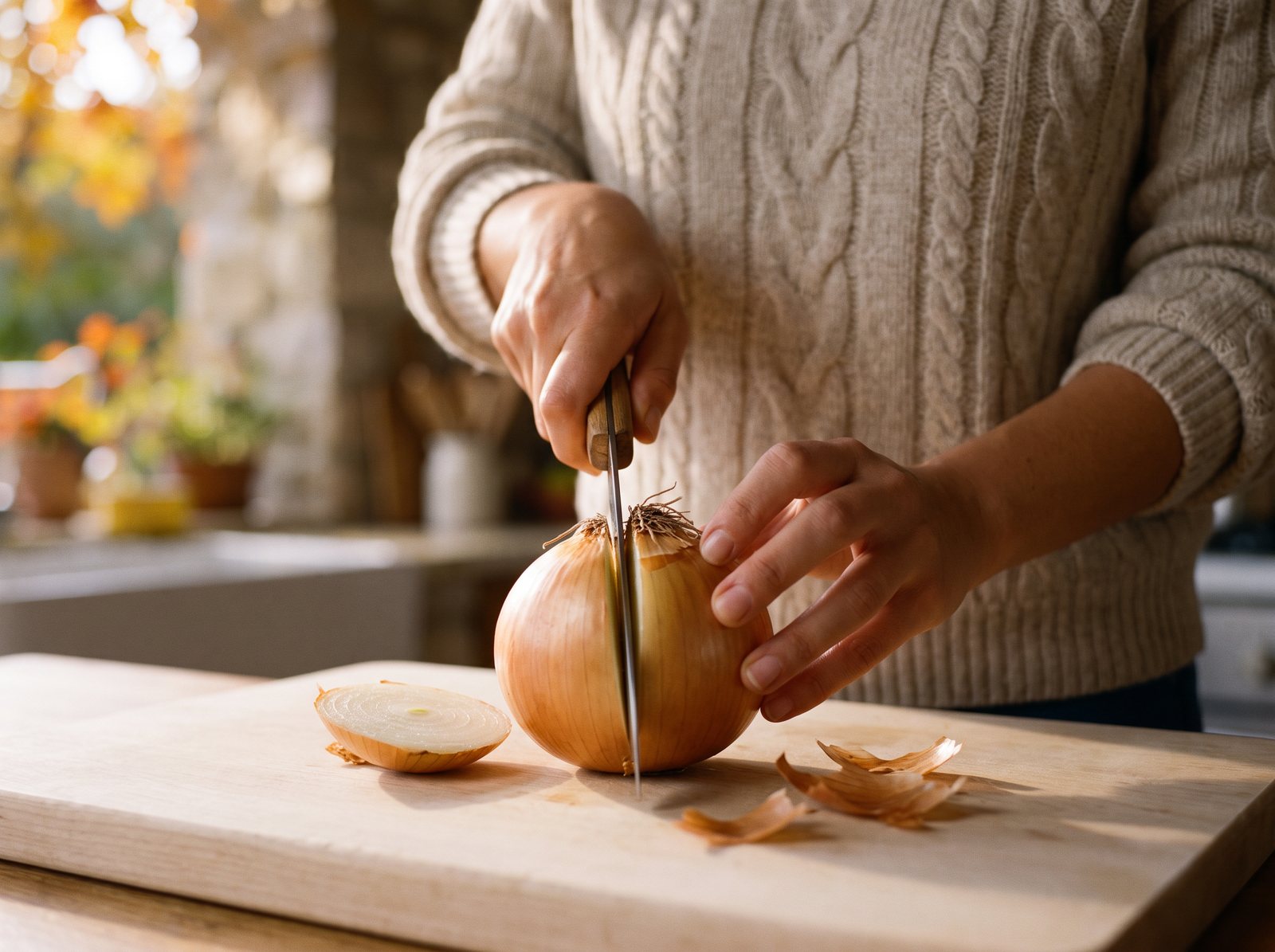
Cut a thin slice off the stem tip, the pointed end opposite the root. Leave the root alone. Stand the onion on that flat cut end and halve it straight down through the root, so each half keeps a piece of root plate holding its layers together.
Tip: Trim only the dry hairy roots from the root end, not the plate itself. It is your handle and your glue.
Peel
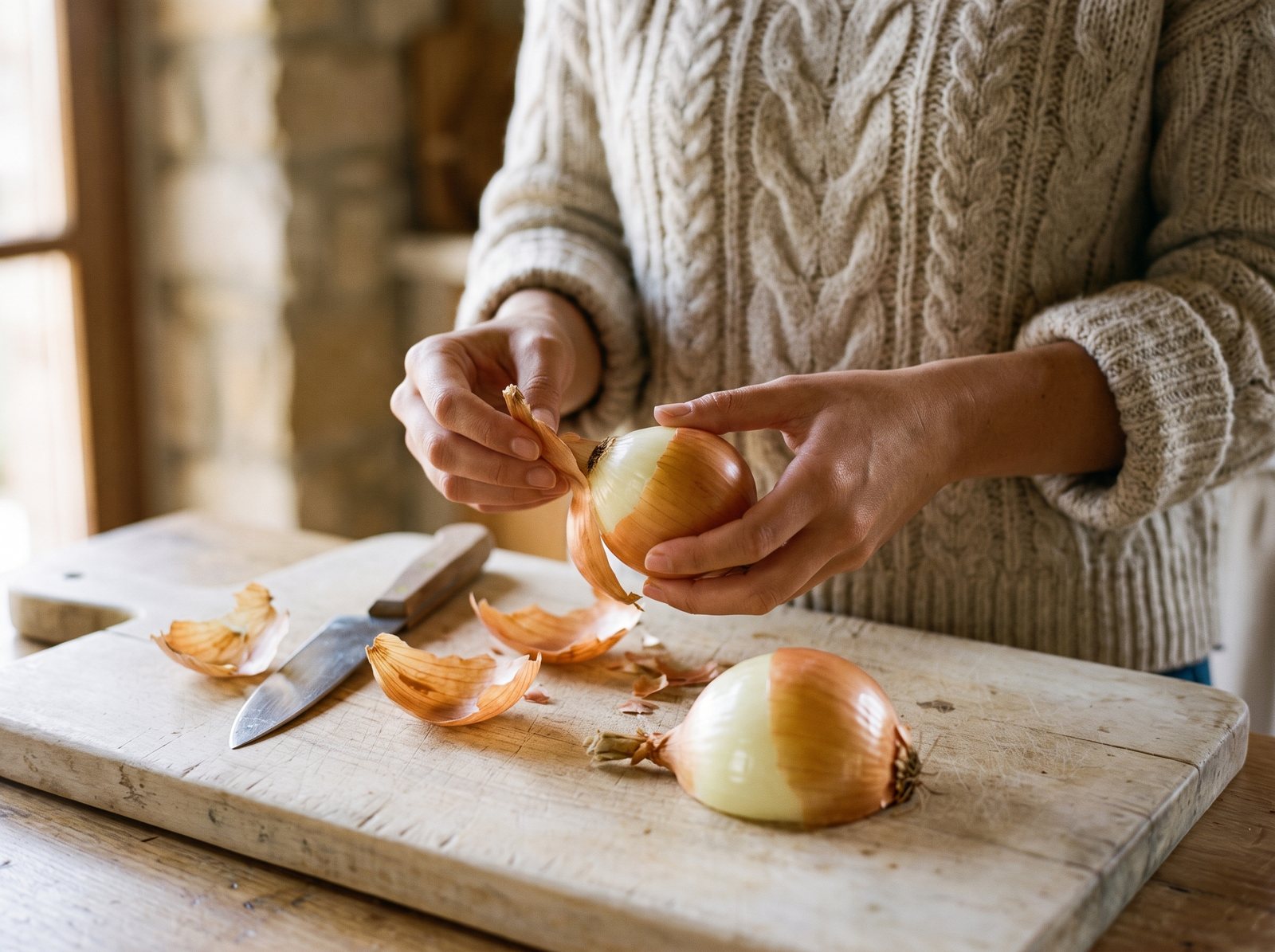
Pull off the papery skin from each half, starting at the trimmed tip. If the first fleshy layer is tough, leathery or blemished, take it off too. Lay each half flat side down. It now sits steady and cannot roll.
Tip: A thin-skinned or stubborn onion peels faster if you slit the skin with the knife tip and peel it back with the first layer.
Make vertical cuts toward the root
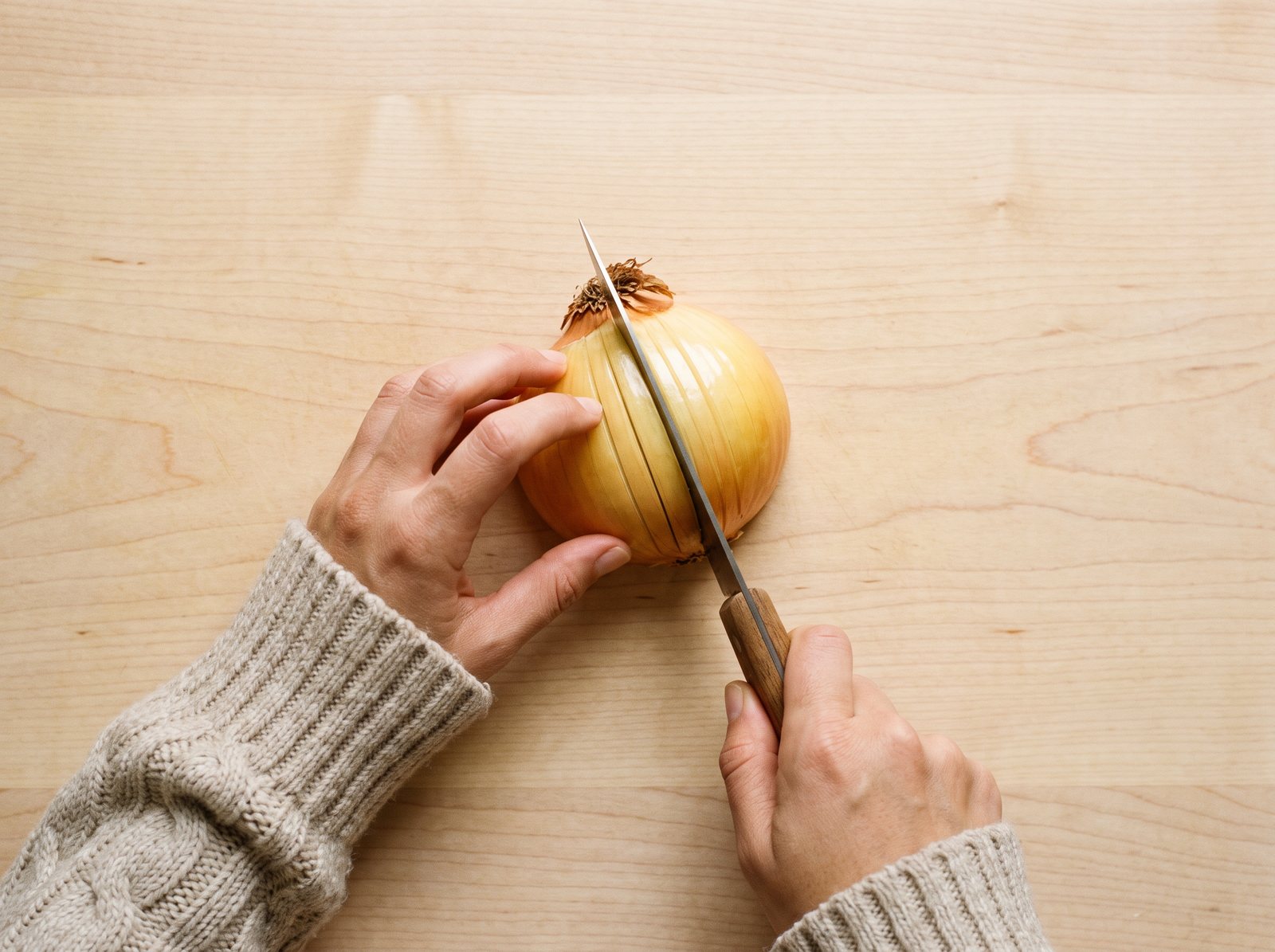
With the root end away from you, slice down through the half from the trimmed end toward the root, stopping 5 mm or so short of it. Space the cuts at the size of dice you want. Keep the tip of the knife pointing at the root and the claw on top holding the half together.
Tip: Lift the heel and let the tip do the cutting. You only need the very front of the blade for these.
Decide on horizontal cuts
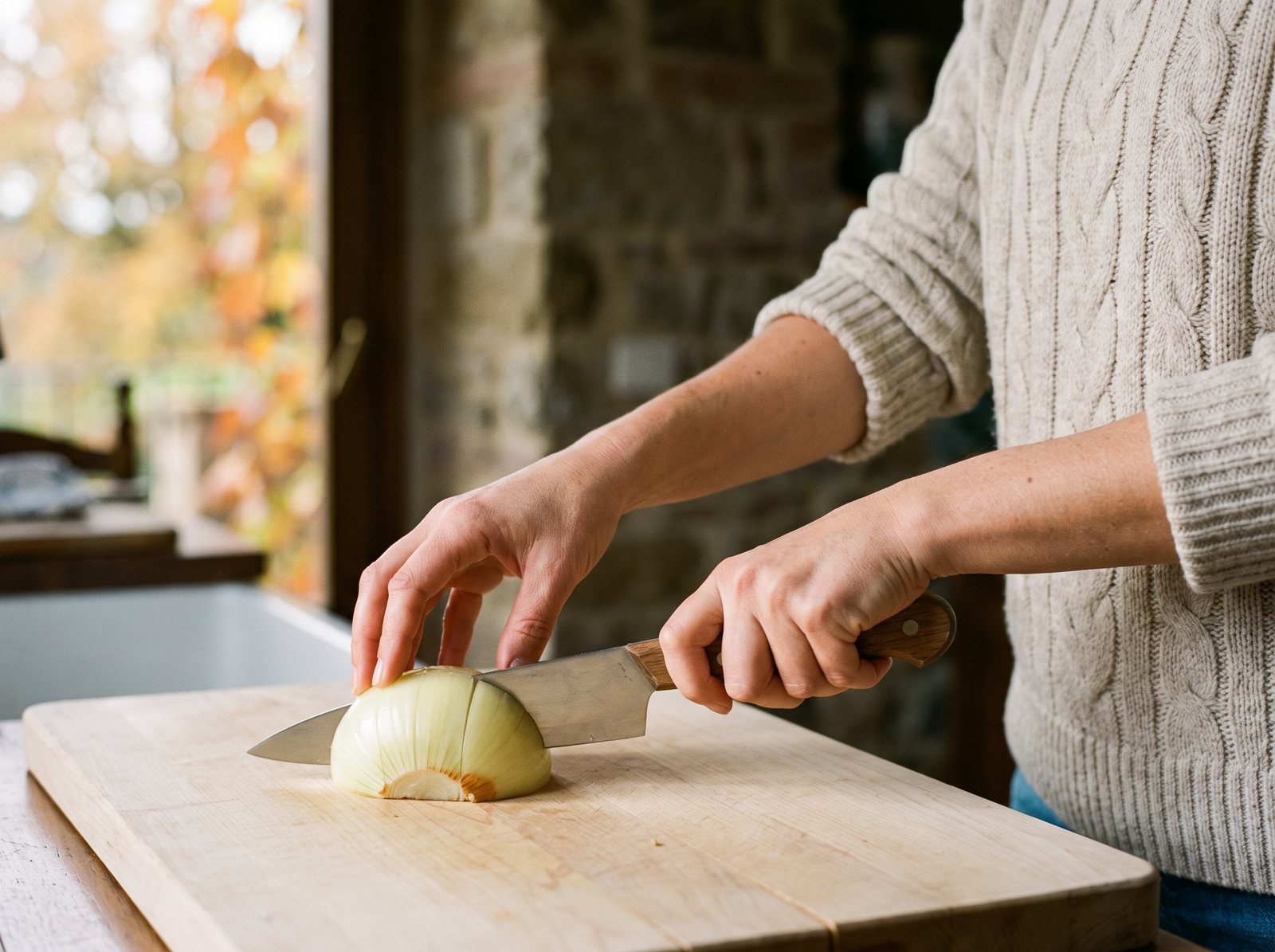
The classic method adds two or three horizontal cuts, blade parallel to the board, from the trimmed end toward the root. Many chefs now skip them. The layers already give you divisions in that direction, and horizontal cuts mainly add a little evenness at the risk of your fingers. An alternative is radial cuts: angle each vertical cut so it points at the centre of the onion's core, like spokes. The pieces from the outer layers then come out closer in size to those from the middle.
Tip: If you do make horizontal cuts, keep your guiding hand flat on top of the onion, fingers raised away from the blade's path, and cut slowly.
Cut across and control the size
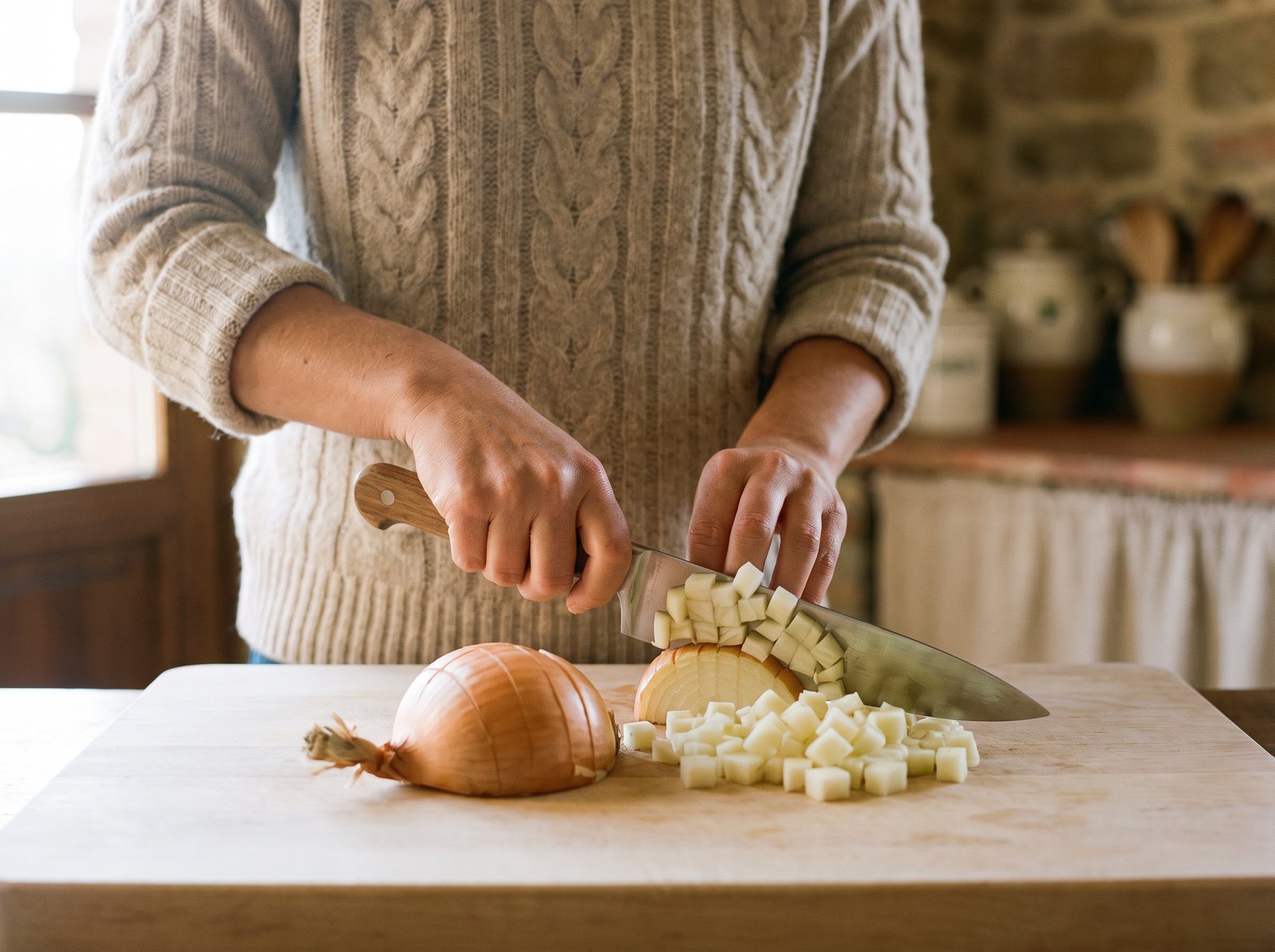
Turn to cut across the vertical cuts, starting from the trimmed end and working back toward the root. Each slice falls away as dice. The spacing of these cuts, matched to the spacing of the vertical cuts, sets the size: about 3 mm for fine, 6 mm for medium, 12 mm for large. When you reach the root, stand the stub on its side and dice what remains, or keep it for stock.
Tip: For an even finer result, run the knife through the pile with a rocking motion afterwards, but stop before the onion turns wet and pulpy.
Slice half-moons and pole-to-pole
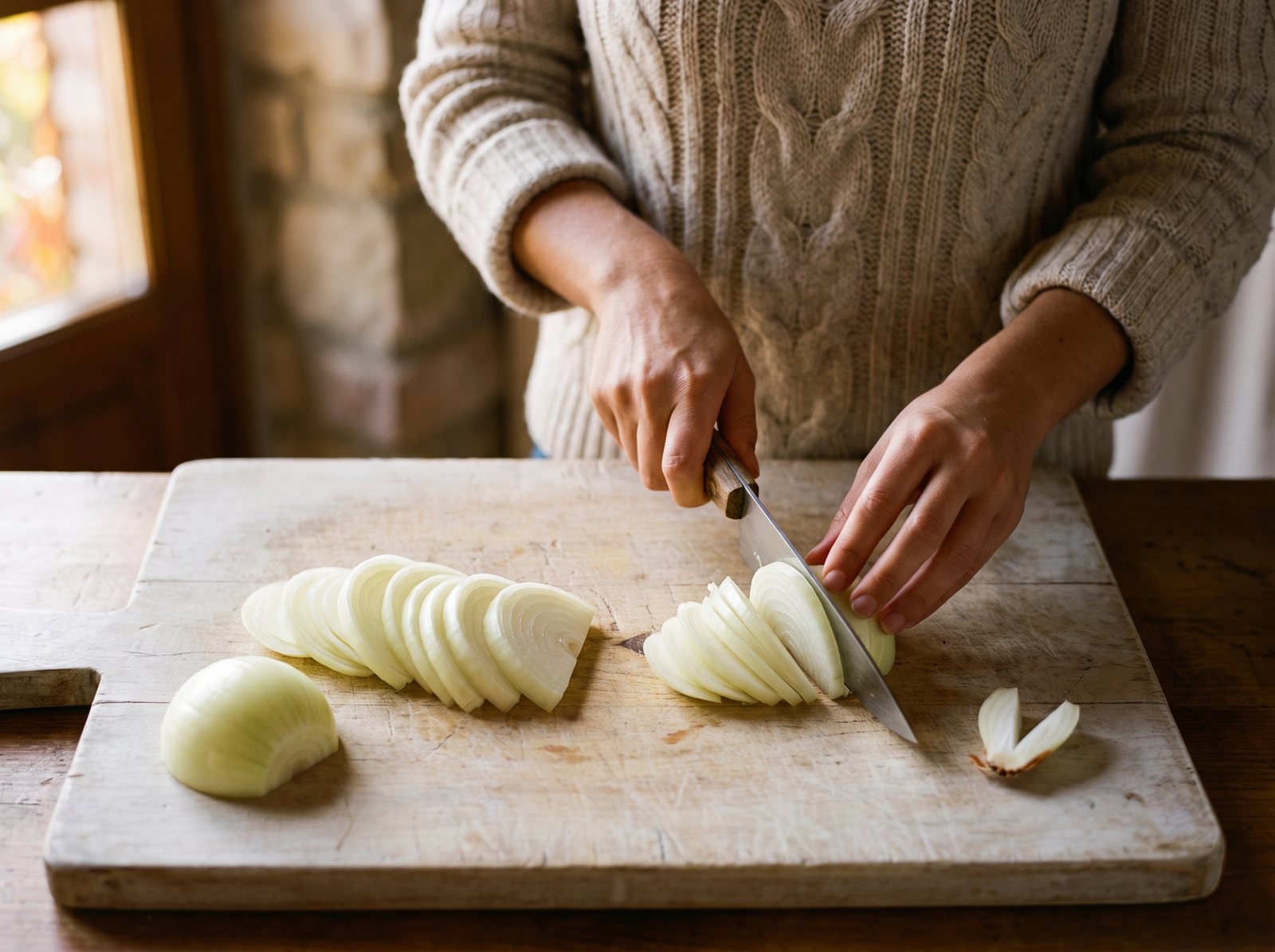
For half-moons, lay a peeled half flat and slice straight across, from tip toward root, in even slices. These cut across the grain and soften quickly. For pole-to-pole slices, cut the root plate out of the half with a V-shaped notch, then slice along the lines running from root to tip, angling the knife toward the centre as you go round. These hold their shape and are the cut to use for caramelising, stir-fries and fajitas.
Dice shallots the same way, smaller
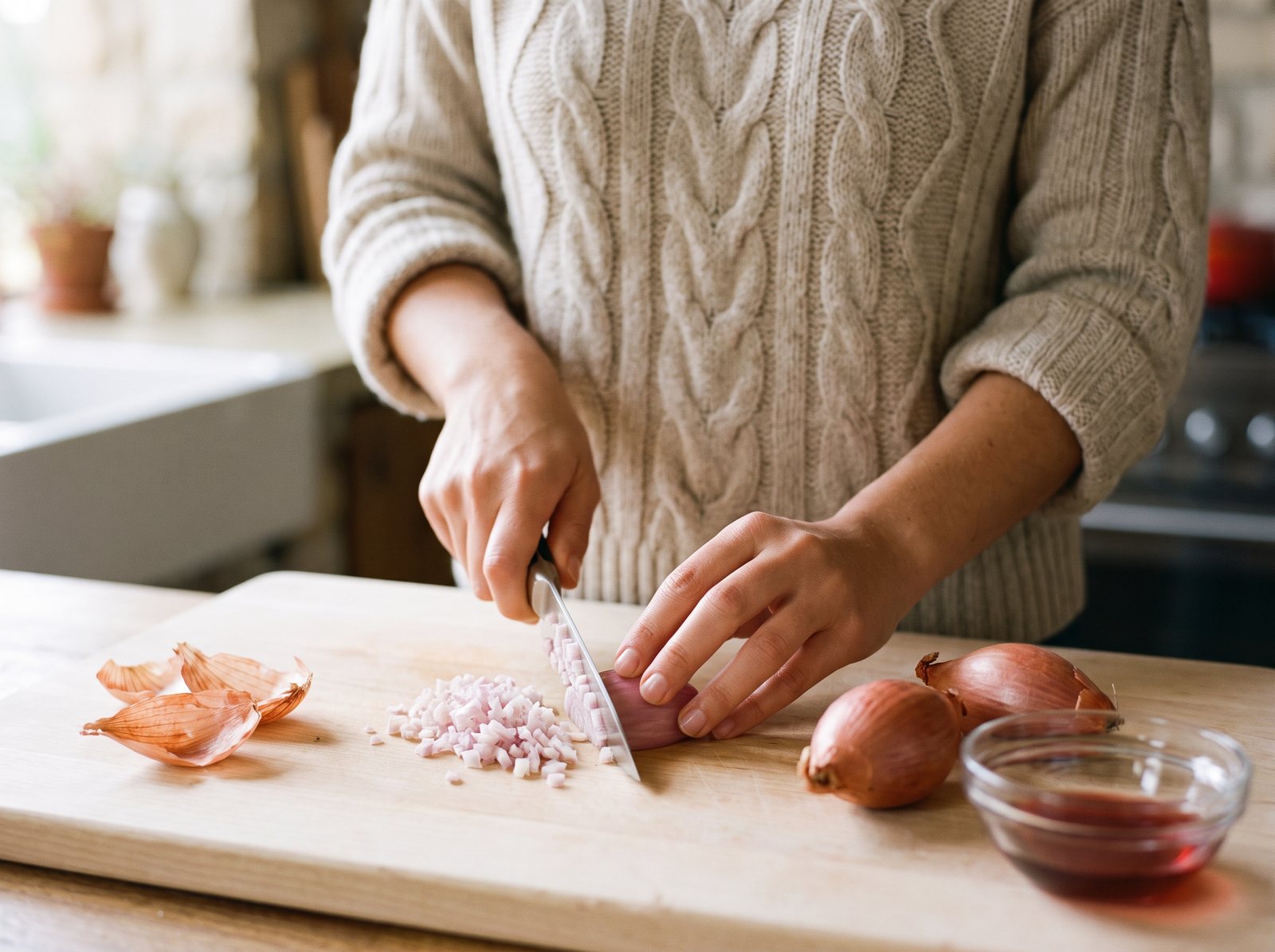
Trim the tip, halve through the root and peel. Many shallots split into two or three cloves inside their skin; separate them and treat each as a small onion. Make close vertical cuts, skip the horizontal ones, and cut across for a fine 2–3 mm dice.
Tip: For a vinaigrette or a mignonette, cover finely diced shallot with the vinegar for 10 minutes before adding oil. The acid softens its bite.
Crush, peel and cut garlic
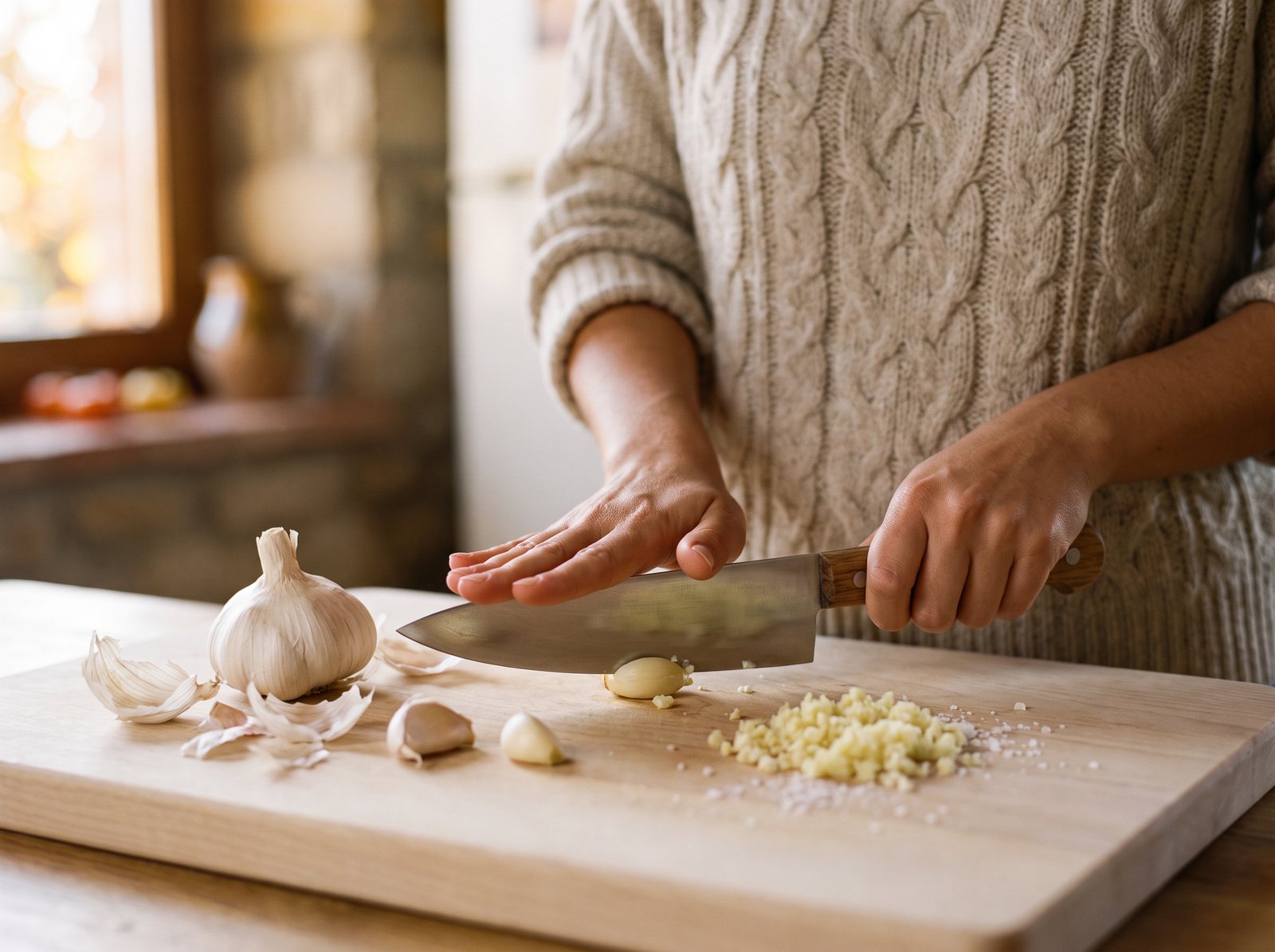
Lay a clove under the flat of the blade and press down sharply with the heel of your hand. The skin cracks and slips off. Slice it thinly, or mince it by rocking the knife through the slices. For a paste, sprinkle a pinch of coarse salt over the mince and drag the flat of the blade across it, pressing, until smooth. A microplane gets you a fine purée in seconds.
Tip: The more you break garlic up, the stronger it tastes, because crushing creates allicin, the sharp compound. Thin slices are mild, mince is stronger, grated or pasted is strongest. If the clove has a green shoot in the middle, older garlic can taste bitter there; pull it out.
Prepare spring onions and leeks
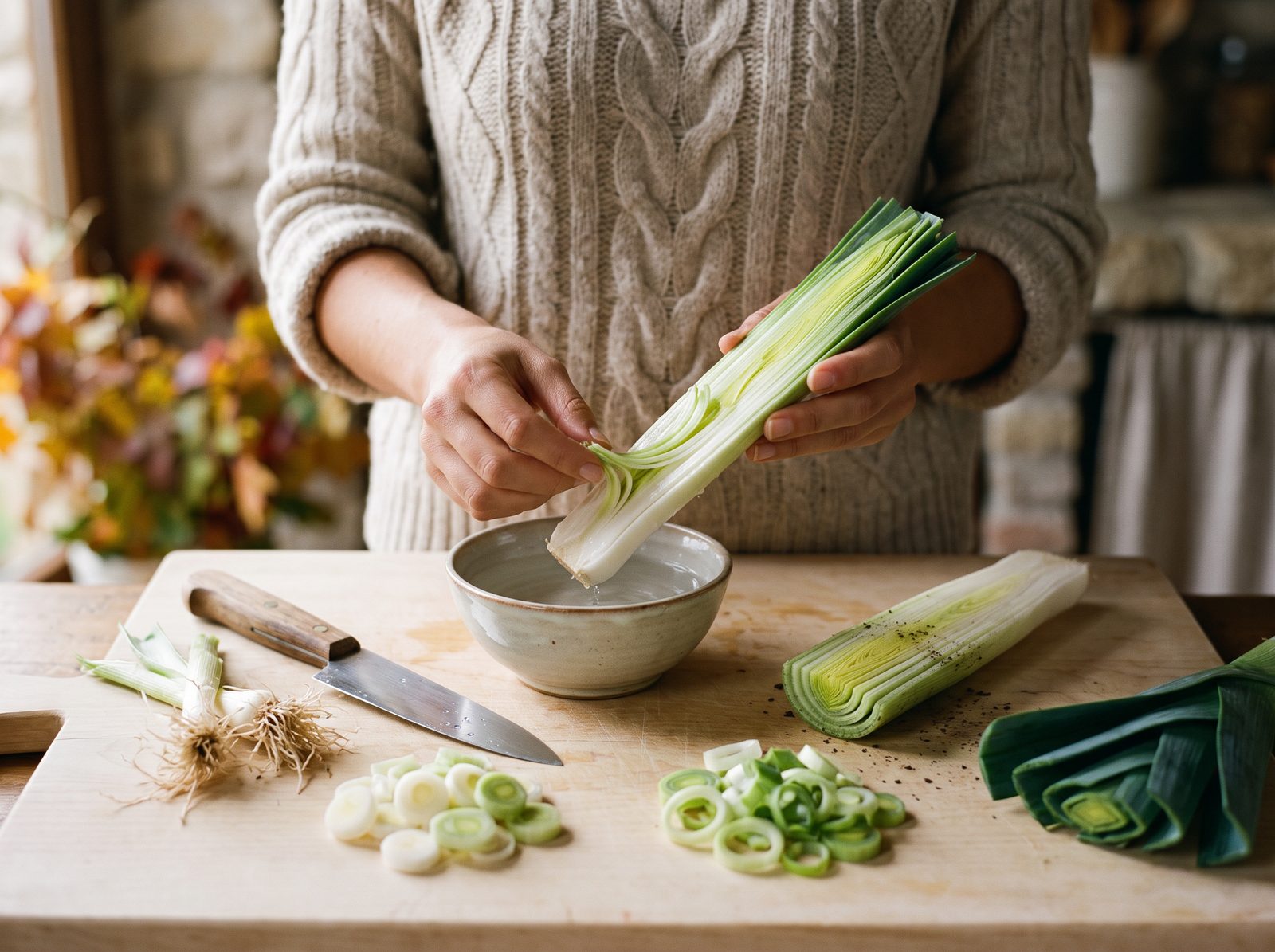
Trim the roots and any limp tops from spring onions, then slice the white and pale green part and the dark green separately: the whites go in early to cook, the greens go in at the end or raw on top. Leeks hold grit between their layers. Trim the root and the tough dark green, halve lengthways and rinse each half under the tap, fanning the layers open with your fingers. Then slice or dice.
Tip: For sliced leeks, you can slice first and swish the pieces in a bowl of cold water instead. Lift them out with your hands so the grit stays at the bottom.
Onions and their relatives
| Type | Flavour | Best for |
|---|
| Yellow (brown) onion | Pungent raw, deep and sweet when cooked | The all-purpose onion: soffritto, stews, sauces, caramelising |
| White onion | Sharp, clean and crisp, less sweet when cooked | Mexican cooking, salsas, quick stir-fries |
| Red onion | Milder, slightly sweet, colourful | Raw in salads, quick pickles, grilling; turns a dull purple-grey in long cooking |
| Shallot | Fine, sweet, gently garlicky | Pan sauces, vinaigrettes, beurre blanc, anything where onion should be subtle |
| Sweet onion (Vidalia, Cévennes) | Very mild, juicy, high in water | Raw slices, onion rings; poor keepers and less flavour in long cooking |
| Spring onion | Fresh and grassy; whites milder than raw onion | Garnish, stir-fries, salads, Asian dishes |
| Leek | Mild, sweet, soft when cooked | Soups, gratins, braises, quiche, slow-cooked melted leeks |
Onion cut sizes and when to use them
| Cut | Size | Use it for |
|---|
| Fine dice | about 3 mm | Pan sauces, risotto, vinaigrettes, salsas, burgers and meatballs; melts into the dish |
| Medium dice | about 6 mm | Most everyday cooking: soups, curries, ragù, chilli |
| Large dice | about 12 mm | Stews, braises, roasting trays, stocks; stays present after long cooking |
| Half-moons | slices 3–5 mm thick | Quick sautés, salads, soups, pickles |
| Pole-to-pole slices | slices 3–5 mm thick | Caramelised onions, stir-fries, fajitas, onion gravy |
Troubleshooting
The onion falls apart while I am dicing it.
The root plate is gone, or your vertical cuts ran through it. Keep the root on and stop each vertical cut just short of it. Hold the half together with your claw while you make the cross cuts.
My pieces come out all different sizes.
Outer layers are wider than inner ones, so straight vertical cuts give bigger pieces from the edges. Try radial cuts aimed at the centre. Then keep the cross cuts at the same spacing as the vertical ones by moving your claw back the same distance each time.
The onions burn before they soften.
The heat is too high, the pan too crowded in one spot, or the dice uneven so the small bits catch first. Turn the heat down, add a pinch of salt to draw out moisture, and stir more often. A splash of water stops browning in its tracks and loosens anything stuck to the pan.
My eyes sting and stream.
Sharpen your knife, chill the onion for 30 minutes and work quickly near an open window or the extractor. Do the onions last in your prep so the cut ones are not sitting on the board. Keep your face back from the board rather than leaning over it.
The garlic burns and turns bitter.
Small pieces of garlic go from golden to burnt in seconds in hot oil. Add it after the onions have softened and the pan has cooled a little, and cook it for 30–60 seconds until fragrant. If it goes dark brown, start again: its bitterness spreads through the whole dish.
My diced onion is wet and smells harsh.
A blunt knife or too much rocking has crushed it. Sharpen the knife and make clean single cuts. For raw use, rinse finely diced onion in cold water and drain well to tame the sharpness.
Knife safety with round vegetables
An onion is round and slippery, which makes it one of the easiest things to cut yourself on. Give it a flat base before anything else.
- Halve the onion first and always cut with the flat side down on the board. Never dice a whole round onion.
- Keep your guiding hand in a claw, fingertips tucked behind your knuckles, with the blade resting against them.
- Put a damp cloth under the board so it cannot slide.
- For horizontal cuts, keep your hand flat on top of the onion and the blade level, or skip them.
- Crushing garlic, press the flat of the blade with the heel of your hand, with the edge facing away from you.
- Keep the knife sharp. A dull edge skids off the shiny skin.
